

How To Use Multiple Desktops On Windows 10
Using Windows ten Multiple Desktops
Tom Fenton believes that multiple desktops will increase your productivity and decrease the clutter on your desktop every bit information technology allows yous to group your desktops by different workflows.

Unfortunately, one of Windows x'south near useful all the same underutilized features shares the same name every bit another -- and perchance more than pop -- technology: virtual desktop. The more mutual use for this term refers to a virtual desktop infrastructure (VDI), which is used to display a virtual auto (VM) to a remote VDI clint. The other technology of the same name allows you to extend your physical monitor to a virtual monitor; for the sake of this article, I will refer to this setup as multiple desktops.
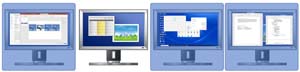
I like to think of multiple desktops as desktops hidden to the side of a physical monitor which can be brought into the physical monitor as needed. For example, yous may ready one desktop to piece of work on a presentation, some other for your general work, another for connecting to remote systems and another for documents. Alternatively, you could fix up different desktops for different projects.For instance, if you practise gig work or have a side hustle, you can accept different desktops ready upwards for different customers.
Although the multiple desktop feature is relatively new to Microsoft OSes, this is an quondam technology that has been used for quite some time with other OSes and every bit a third-party add together-on for Windows systems. The get-go multiple desktop implementations were Amiga 1000, released in 1985, as well as Xerox PARC's Rooms or Switchable Desktops, released in 1986. The concept of multiple desktops really started to catch on with the Solbourne Window Manager for the X Window System in 1989, at which signal Solbourne trademarked the term Virtual Desktop. Now, most Unix and Linux distributions support multiple desktops, and Mac first supported Space, their implementation of multiple desktops, in Mac OS 10 10.seven.
Prior to Windows ten, Microsoft OSes did not support multiple desktops, only there have been 3rd-party products that accept supported them since at least Vista and XP. I have used a few of these products in the by, simply not for extended periods of time as they would presently either get unsupported or would no longer work with updates to the Bone. Needless to say, I was happy to see them as a feature included with Windows 10.
The Task View characteristic allows you to create and manipulate multiple desktops. You can launch it by either clicking its icon in the tool bar, or by pressing the Windows+Tab keys.
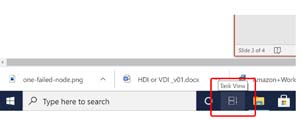
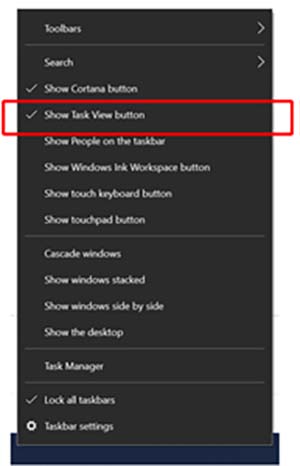
If you do not see the Task View icon, right-click the taskbar, and select the Show Task View button option.
The Task View will so display all of your currently open applications in a grid format. At the top of the screen, it volition likewise display your current desktops, and allow you to create a new desktop if you wish to exercise so. Yous can also create a new desktop by pressing Windows+Ctrl+D.
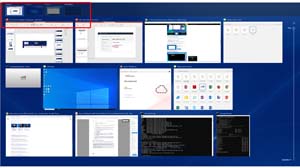
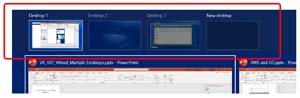
Once y'all have created a new desktop, you tin can navigate to information technology either past selecting it while in Task View, or by pressing Windows+Ctrl+Left or Correct Arrow.
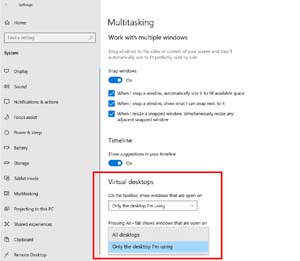
By default, when on a desktop, pressing Alt+Tab will still toggle betwixt applications on that particular desktop. You tin can change this to show all applications on all desktops by going to Settings > Multitasking and selecting All Desktops in the virtual desktops department.
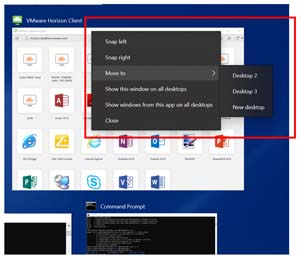
An existing awarding can be moved to another desktop by bringing upwardly Task View, right-clicking the awarding, and selecting Move to. You tin likewise brand an application exist shown on all desktops by selecting Show this window on all desktops.
So, the question everyone wants to know is if virtual desktops (i.e., multiple desktops) tin can be used on a virtual desktop (i.e., remote VM). In my testing on AWS WorkSpaces Desktop-equally-a-Service (DaaS) desktops and on a Horizon desktop, they were immune to be used. The 1 caveat is that the Windows key is not e'er passed through properly to the remote desktop.
Below is a tabular array of keyboard shortcuts for multiple desktops.
| Windows+Tab | Open Task View |
| Esc | Shut Chore View |
| Windows+Ctrl+D | Create a new virtual desktop |
| Windows+Ctrl+Left or Right Pointer | Switch between virtual desktops |
| Windows+Ctrl+F4 | Shut the current virtual desktop |
| Alt+Tab | Switch between applications |
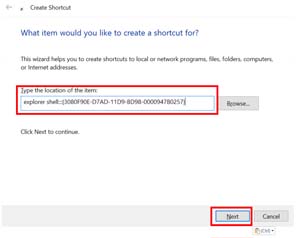
Y'all can add a shortcut to Chore View on a desktop by right-clicking your desktop and selecting Shortcut from the New drop-down card.
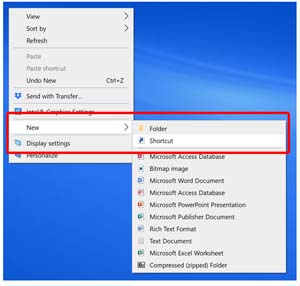
In the text box, enter explorer trounce:::{3080F90E-D7AD-11D9-BD98-0000947B0257}, so click Next.
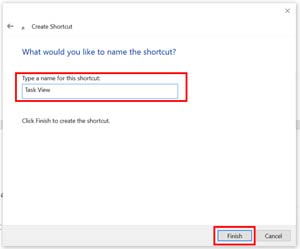
And then, enter Chore View in the text box and click Finish. You will now see this folder on your desktop:
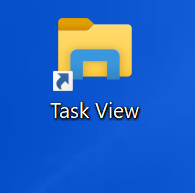
and it will launch Task View:
I firmly believe that multiple desktops will increase your productivity and subtract the ataxia on your desktop as it allows y'all to group your desktops by unlike workflows. In no time at all, yous volition be pressing Windows+Ctrl+Left or Correct Arrow to switch betwixt desktops out of habit, only as yous are used to pressing Alt+Tab to switch between applications now.
About the Author
Tom Fenton has a wealth of easily-on IT experience gained over the past 25 years in a variety of technologies, with the past 15 years focusing on virtualization and storage. He currently works as a Technical Marketing Manager for ControlUp. He previously worked at VMware as a Senior Course Programmer, Solutions Engineer, and in the Competitive Marketing grouping. He has likewise worked as a Senior Validation Engineer with The Taneja Group, where he headed the Validation Service Lab and was instrumental in starting up its vSphere Virtual Volumes practice. He'due south on Twitter @vDoppler.

How To Use Multiple Desktops On Windows 10,
Source: https://virtualizationreview.com/articles/2021/01/04/multiple-desktops.aspx
Posted by: browderhileace.blogspot.com
0 Response to "How To Use Multiple Desktops On Windows 10"
Post a Comment