

How To Pin Things To Start Menu Windows 8
Wanna exist startin' somethin': a history of the Windows Commencement menu
Microsoft's most identifiable production has had 20 years of ups and downs
Past Tom Warren | Illustrations by T.C. Sottek
Microsoft's Start card is a big deal. It's the outset thing many people recollect of when they remember of Windows, or even Microsoft. The simple Start menu has existed for more 20 years now. Information technology started off every bit a way to brand Windows easier to use, and now it'southward the center of how nosotros interact with Windows on a daily basis. Whether it'due south launching apps, searching for documents, or simply shutting downwards your PC, you probably utilise the Start menu more than you lot think.
Microsoft's Outset bill of fare made its beginning appearance with Windows 95. It rapidly became the go-to menu to find everything you needed from your PC, and information technology changed very fiddling until the blue-and-green theme of Windows XP. The Commencement menu became so intertwined with the identity of Windows that users freaked out when it disappeared in Windows 8. Information technology didn't take long for Microsoft to opposite grade: the Outset bill of fare was brought back to life with Windows 10.
Microsoft has tried a variety of different Start menus over the years, but the Windows 10 version is the all-time combination of the modernistic ideas the company has attempted and the classic carte. The Outset menu is iconic, and it's the identity of Windows. As long as Microsoft doesn't have whatever crazy ideas, it's probably here to stay for many, many more years.
Twenty years is a long time for any software, so let's take a look at how exactly the Offset menu, and past extension, Windows itself, has changed since Windows 95.

Start me up
Windows 95 Back in 1995, people lined up at midnight to get Microsoft'due south latest release of Windows, and it was the first version, alongside the enterprise-focused Windows NT 4, to introduce the First bill of fare. It was designed to brand Windows easier to use, and group or organize applications in a listing. Before it arrived, Windows users could access apps through Plan Managing director. Information technology was largely a basic list of apps, with no existent organization. While Programme Manager did take smaller menus, most Windows users merely launched apps and used information technology as a listing. Windows needed an overhaul. The Offset bill of fare was just that overhaul to bring Windows into the next era of computing.
Windows 95's Showtime menu arrived alongside the taskbar. The taskbar offered quick admission to book options, the time and date, and fifty-fifty an indication of network activity. Any apps that you launched in Windows 95 would sit neatly on the taskbar, making them easy to leave open and access repeatedly, and you'd find nearly of them from the new Beginning menu. Microsoft kept the idea of a listing of apps in its new menu, but it was laid out into categories and neatly organized and you could simply elevate and drop apps into place. The menu itself became the default way to launch apps from a simple click of the Start push button.
The combination of Start button and menu meant you always activated the carte from the lower left-hand side. Even when other apps were used, the Start button was always visible and set to be used to admission additional apps or folders. Information technology negated the need to utilise Control Prompt for the vast majority of users, and became familiar equally the first place you lot'd bank check to notice documents, help, settings, or just the ability to plough your PC off.
It kickstarted a tendency in Windows that has lasted more than than 20 years, and made information technology like shooting fish in a barrel for people new to computers to easily navigate around. The Offset menu was too an efficient way to store and organize a lot of quick shortcuts in one place.
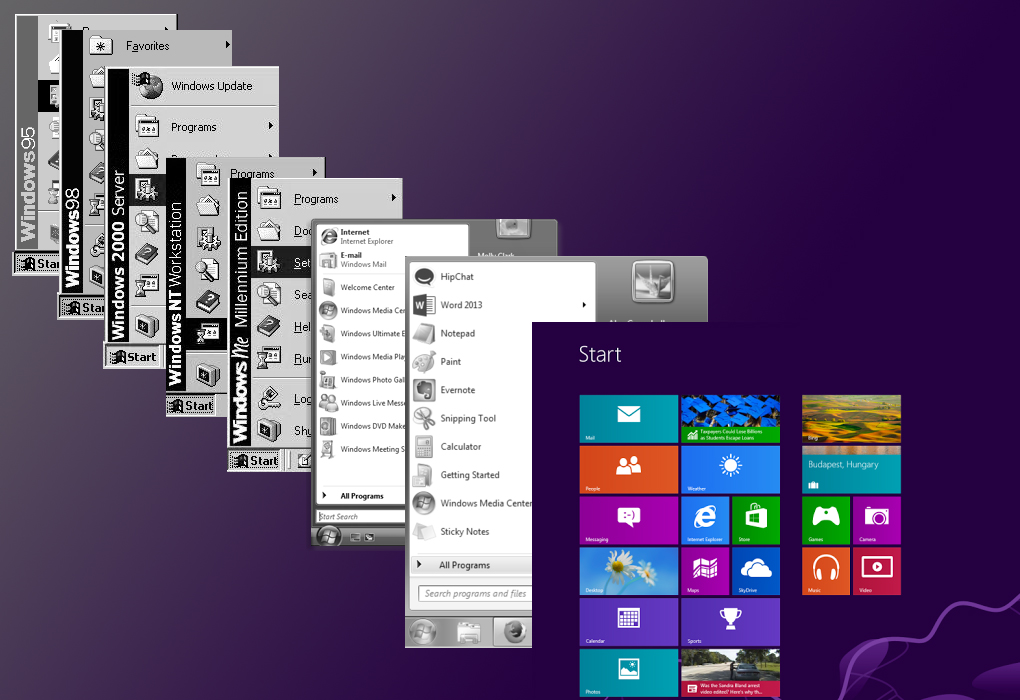
Windows 98 - 2000 At first glance, the Windows 98 Starting time menu doesn't wait very unlike to the original. A new log off option to support 98's new multi-user interface was added alongside the same iconography, layout, and basic functions as the Windows 95 version. Beyond that, Windows 98'southward Start carte ushered in the cyberspace era. Microsoft added a favorites folder on the Start carte du jour to complement the bundling of Internet Explorer with Windows 98. Virtually of the internet-related features were designed for the agile desktop with widgets, but the Windows 98 Kickoff menu played a small, but important role in making Windows a lilliputian more cyberspace friendly.
The taskbar saw bigger changes. Microsoft introduced a new Quick Launch department that let Windows 98 users pin their favorite apps. Quick Launch likewise included the "show desktop" choice to quickly check the desktop and minimize open up apps, even when apps were maximized to take up the unabridged screen. As the desktop contained widgets and Windows users love to save documents to the desktop, the show desktop feature became a useful pick to complement the taskbar, desktop, and Outset bill of fare.
Windows ME might take been full of bugs and issues (it didn't earn its nickname "Windows Mistake Edition" for nothing), merely the Start menu remained a consistent and stable feature. Little changed from the Windows 98 version, just Microsoft decided to place the full Windows ME branding forth the side of the menu. That made it await a niggling ugly, but it was the terminal fourth dimension nosotros'd run into this type of layout and design for the default version of the First menu.
Windows 2000 was designed for professionals, only the Starting time menu was almost identical to Windows ME. Microsoft fabricated some minor changes to pin Windows Update and set program admission and defaults to the tiptop of the Start carte. It was a quicker fashion to admission settings to uninstall apps or change default apps, and the Windows Update shortcut was designed to provide quicker access to all of import security updates.
Just like Windows ME, the taskbar in Windows 2000 remained relatively unchanged from Windows 98. This is the last time we'll run into the traditional grayness interface as the default setting for the Start menu.

New experiences
Windows XP - Windows seven Windows XP gave usa the showtime meaning visual overhaul to the Get-go carte du jour since Windows 95. Information technology looked radically different. Microsoft picked a bluish-and-greenish theme for XP's Start carte, and many were quick to criticize its "Fisher Toll" look at the time. The blueish theme extended into the entire taskbar, and Microsoft began tweaking the arrangement tray to hide unused icons past default. It was piece of cake to get them dorsum and driblet them into the full system tray, but it helped keep the system tray under control at a fourth dimension when many app developers started taking advantage of information technology.
The bodily Kickoff carte itself split up into two panes, with regularly used or pinned apps on the left and quick access to documents, settings, assistance, and search on the right. It was familiar, but also very different. The traditional application list on the Get-go bill of fare was accessible from the All Programs link, and if you actually wanted the old Start menu dorsum then you could enable a classic theme. At the time, a lot of third-party skinners produced a diverseness of themes to customize the Offset bill of fare and overall look of Windows XP.
Microsoft took its Windows XP Beginning menu changes and tweaked them fifty-fifty further with Windows Vista. While the Starting time carte looked like, there were some central changes that alienated longtime Windows users. Microsoft switched to a transparent menu equally function of its futuristic-looking "Aero Glass" theme. It was a visual look that many enjoyed, but the translucent effects were likewise distracting and irritating at times, not to mention taxing for a lot of older and lower-cease PCs. Microsoft extended this theme throughout the Starting time card, app windows, taskbar, and even in a new sidebar that independent live gadgets.
The Commencement menu itself inverse to a darker look and feel, with simple icons in the taskbar for the Show desktop choice and a new 3D flip interface that tiled apps together. Vista's Start bill of fare lacked whatsoever visual cues for links to documents, the command panel, or other settings, which made it hard to browse rapidly and access these options. It was a long list of text on the right-hand side, and frequent or pinned apps on the left.
Microsoft'southward biggest alter to the Vista Beginning menu came with congenital-in search. In Vista you could simply hitting the Windows fundamental and outset typing for what you wanted to search for. The importance of the Windows key or Windows logo permeated throughout Microsoft's keyboards and mice, and a new "ultimate" keyboard shipped with the Windows primal in the center to rapidly access search or the Start menu. Microsoft as well removed the "start" branding from the Vista Kickoff menu, and replaced it with a Windows orb to further push the Windows branding in Vista.
Continuing the trend of tweaks over the years, Microsoft made very few changes to the Start menu with Windows vii. The shutdown button became more prominent and like shooting fish in a barrel to spot, just Microsoft kept the lack of visual elements and apartment text for shortcuts. Microsoft tweaked its search feature for the Windows 7 Offset menu, with better performance and faster queries for documents and settings.
Virtually of the Windows 7 interface changes were found in the taskbar or the way apps interacted with each other. Microsoft introduced Aero Snap to permit Windows 7 users snap apps side by side. Aero Shake also appeared and allowed users to shake their mouse to initiate the Bear witness desktop command. Microsoft even moved the traditional Evidence desktop shortcut from the Quick Launch surface area to the correct-hand side of the taskbar.
The offset is the end is the beginning
Windows 8 - Windows ten Microsoft decided that it was done with the Start menu for Windows eight. It turned out to exist a mistake that alienated and panicked Windows users. The familiar Start carte du jour was replaced with a fullscreen Start screen with colorful Alive Tiles. Windows 8 was the about drastic modify to the Start menu in its entire existence, and the nigh drastic change to Windows itself.
Microsoft removed the familiar Get-go button because the company was focusing on fullscreen bear upon-friendly apps and design. It made navigating to this new Starting time screen very difficult. The Offset screen itself was designed to look simplistic, but using it was anything but. Microsoft shipped the start version with the built-in apps pinned by default, simply no quick admission to search or shutdown options. It confused longtime Windows users and proved difficult to learn for new users, and was largely considered too much of a change from the Start menu that existed before.
Most of the changes to the Start menu were related to Alive Tiles. These new tiles were designed to promote a new type of app that developers could build. The new "Metro-style" apps ran fullscreen and were mainly designed to exist finger-friendly to position Windows 8 as a tablet / desktop operating organization. Apps used Live Tiles that stood out on the new Start screen, just it made it more hard to find the traditional desktop apps that Windows users were accepted to working with. The traditional desktop was designed to be only another app, with the Start screen taking control of the entire interface.
With the desktop as an "app," that meant the taskbar was besides subconscious away by default. Most Windows users had grown used to finding the date and fourth dimension in the lower left-hand side of their screen, just this disappeared unless you hovered your mouse to the four hot corners Microsoft created. It was hard to navigate, and it was clear that nearly Windows 8 users just wanted the Start menu back. Some got used to it, simply many downloaded 3rd-party apps to bring back the familiar Start carte du jour; i.v 1000000 people downloaded a Showtime menu replacement in only a few months from the launch of Windows 8, signalling that Microsoft had more than work to do to make people happy with its new Start screen.
Faced with negative feedback from the introduction of Windows 8, Microsoft was forced to address some of it with its Windows 8.one update. The Offset screen persisted, simply Microsoft added shutdown and search options, and brought back the familiar Start push in the lower left-paw side. There was a modest visual pointer to gyre downwards to access a listing of all apps, simply the Start screen nonetheless wasn't a popular pick for nigh Windows users.
Information technology still felt similar the desktop was hidden underneath this new impact-friendly interface, and many still found it difficult to find.
Windows 10 was actually designed to continue the good aspects of Windows 8, but bring dorsum some of the familiarity of Windows 7. Microsoft listened to the feedback this fourth dimension, but instead of but bringing back the old Start carte du jour from Windows 7, the software maker took the former menu and merged it together with its new Live Tiles. The Tiles serve as a colorful and large canvas to launch or pin favorite apps on the right paw-side, and the left keeps quick admission to shutdown options, settings, all apps, and the familiar most used apps column.
Microsoft moved the visual search elements of the Start menu down into the taskbar, merely you tin all the same blazon to search in the Windows 10 Commencement menu and it'south all function of the same interface. Microsoft's Cortana digital assistant now sits in the taskbar alongside the Start menu and a new Task View pick for a quick view of open apps and virtual desktops. All these changes were designed with desktop and laptop users in mind, and to make everything a lot more familiar and easier to use at the same fourth dimension.

If you lot're coming from Windows 7 and you upgrade to Windows 10, it's far less jarring than the Windows viii Start screen experience. Microsoft tried to push a bear on-friendly UI in Windows eight, but information technology has clearly retreated back to the familiarity of the desktop.
The overall interface in Windows 10 is a mix of black and white in most areas. Built-in apps make use of this design the most, but the taskbar and First carte mix a blackness theme with touches of transparency. Windows 10 was released more six months ago, and information technology appears that most Windows users are happy that the Start menu is back with a fresh design and new features.
The Start carte appears to exist back with a vengeance, and this time, it's hither to stay.
* *
Edited by Dan Seifert
Source: https://www.theverge.com/2016/2/11/10923808/microsoft-windows-start-menu-20-years-visual-history
Posted by: browderhileace.blogspot.com
0 Response to "How To Pin Things To Start Menu Windows 8"
Post a Comment